
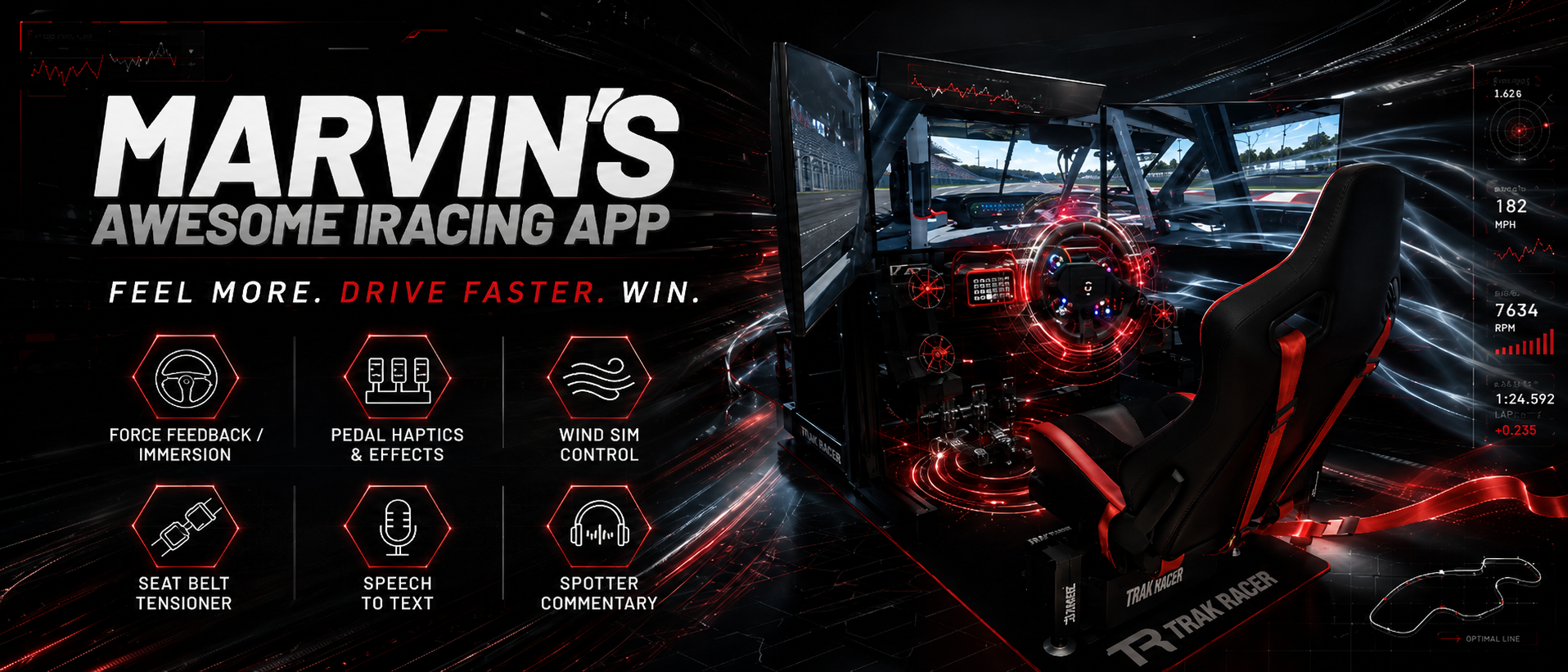
MAIRA (Marvin’s Awesome iRacing App) is a high-performance companion for sim racers who want more immersion, more insight, and more control—without the usual spaghetti of plugins and workarounds. Built from the ground up using real-time iRacing telemetry, MAIRA drives advanced features like highly tunable force-feedback, pedal haptics, and wind simulation that react instantly to what the car is actually doing. Every subsystem is engineered for precision, low latency, and stability, turning raw data into something you can feel, see, and trust. In short: MAIRA doesn’t just show you the race—it helps your rig experience it… preferably at hurricane levels of awesome.

Donations are completely optional. I will never charge any fees for using MAIRA. That said, donations make me warm and fuzzy and is a great motivator for me to keep working on MAIRA. A huge thank you to everybody who have donated already! ❤️

Version 2.1.4488

This Version

Upgrading from 2.0: everything carries over. Your force feedback algorithm choice is mapped to the matching built-in FFB graph, and every FFB value you tuned in 2.0 (algorithm knobs, soft lock, wheel centering, crash and curb protection, steering effect forces and vibrations) is converted into that graph’s module values in every tuning profile. FFB recordings made with 2.0 use an older format and no longer load — six fresh recordings are included, and you can record your own.

If you tried the withdrawn 2.1.4483 build and the update failed: as long as you have not installed 2.1 again since, your settings are safe — they were moved to Documents\MAIRA, and this version knows to keep them when it tidies up the fresh defaults folder the old version created. Just install this version, either from the app’s update prompt or by running this installer. If you did already install 2.1.4483 a second time and it started up with default settings, I am sorry — that build overwrote your settings with the defaults, and they cannot be recovered.

  • Brand-new modular FFB graph system that replaces the fixed force feedback algorithms!
    • Design your own force feedback processing chain in a visual node editor — add modules, drag them around, and wire them together freely.
    • Includes a library of sources (60 Hz and 360 Hz torque, LFE, soft lock, wheel centering, wheel velocity, friction), DSP modules (filters, compressors, slew limiters, adaptive smoother, transient enhancer), mixers, and effects (crash and curb protection, speed gain, steering effect forces, torque dither).
    • The wheel vibration effects live in the same graph as generator nodes — understeer, oversteer, and seat-of-pants vibration, shift RPM, gear change, ABS, plus the brand-new engine RPM, road texture, and slip texture effects. Selecting the Output node previews the complete wheel signal, vibrations included.
    • Four built-in graphs ship with the app — Low latency 360 Hz detail booster & limiter (the flagship), Low latency 60 Hz detail booster & limiter, 360 Hz slew & total compression, and Hybrid multi adjustment toolkit — with their names and descriptions translated into all languages.
    • Coming from 2.0, each car/track context’s old algorithm selection automatically picks the matching built-in graph — the Native 360 Hz, Detail Booster, and Delta Limiter families map to the flagship, Native 60 Hz to the 60 Hz graph, and the Slew and Total Compression and Multi Adjustment Toolkit algorithms to their namesake graphs — and your tuned 2.0 values are converted into that graph’s module values.
    • Built-in graphs cannot be renamed, deleted, or structurally changed (their settings are still adjustable), are updated automatically by new app versions, and can be cloned into fully editable custom graphs.
    • Graphs can be exported to .mairagraph files and imported, so you can share them with other users — and importing a graph you already have lets you apply the file’s module settings to the current car/track context, to the baseline, to both, to every context where that graph is selected, or import it as a separate copy.
    • Module knobs, module switches, and each node’s enable toggle can be bound to controller buttons (right-click the control), and every module setting follows your per-car/track context switches.
    • The first-run wizard’s FFB style step tunes the flagship built-in graph’s detail gain from 25% (silky smooth) to 200% (a lot of boost).
  • The FFB graph section has a simple, beginner-friendly face.
    • The node graph is hidden by default — a "Show node graph" switch in the editor’s top corner reveals the full editor for advanced users, replacing the old simple mode switch.
    • Any module setting — including a node’s enable toggle — can be pinned to surface in the quick controls: the handful of knobs a graph’s author means for everyday tuning. Pins are saved in the graph and travel with export/import.
    • The pinned quick controls live in their own "FFB graph settings" section, grouped by node with each group led by the node’s name and description — and on custom graphs the groups can be reordered.
    • Every graph and every node carries a description — shown under the graph selector, under the module’s settings, and as the node’s hover tooltip. Both are freely editable on custom graphs and translated into all languages on the built-ins.
  • New tuning profile manager!
    • MAIRA has always saved your settings into per-car, per-track, and per-weather tuning profiles behind the scenes — the new manager finally makes them visible: click the car/track/weather display at the top right of the app (or use the new "Tuning profiles" app menu item) to open it.
    • Every profile is listed by how specific it is — the default profile first, then per weather, per car, per car + track, and per car + track + configuration — with the profiles currently in use marked "Active".
    • Selecting a profile shows exactly which settings it changes compared to the default profile, organized by page, group, and setting — and the default profile lists every setting, highlighting values that differ from the factory defaults. FFB graph module values are included, grouped by graph and node.
    • Small scope icons (car, road, wrench, raindrop) show which settings are saved per car, track, configuration, or weather.
    • Every row has a revert button, and whole profiles can be deleted, copied into another same-scope profile, or promoted to become the new default baseline.
    • A "Clean up" button tidies the settings file — it removes stale FFB module values, repairs broken graph selections, and deletes profiles that no longer change anything, always showing the counts and asking first.
    • The per-setting context switches are now hierarchical — per track requires per car, and per track configuration requires per track (older settings files are adjusted automatically).
  • New settings backup system.
    • MAIRA now keeps up to 50 timestamped backups of your settings in Documents\MAIRA\Backups — one shortly after the app starts, then at most one every 15 minutes.
    • If the settings file and its quick backup are both damaged, the app automatically recovers from the newest usable backup at startup.
  • Strength settings are now stored directly in Nm.
    • Every vibration strength, the steering-effect forces, the friction source, and the torque dither store their strength as a torque in Nm at the wheel instead of a percentage of the wheel force setting.
    • The value keeps its meaning when you change the wheel force setting, and a shared graph feels the same on a different wheelbase.
  • The FFB engine now runs the entire processing chain at a full 360 Hz, with a dedicated high-rate output thread driven by a high-resolution timer, and a performance pass eliminated steady-state memory allocations — for smoother, more consistent, hitch-free force delivery.
  • New 360 Hz and 60 Hz prediction FFB modules!
    • Both predict the force feedback signal up to 33 ms into the future to counteract latency between the simulator and your wheel, continuously learning from the torque signal plus your steering and the car’s chassis motion — adapting to every car within a few corners.
    • The 60 Hz prediction module is built for the 60 Hz source, where torque history alone predicts nothing — it leans on your steering and the car’s motion instead.
    • Horizon (in milliseconds), correction limit, and strength knobs let you tune how far ahead they look and how aggressively they correct. The Low latency built-in graphs include prediction out of the box.
  • New Interpolator FFB module!
    • Removes the staircase steps from 60 Hz signals by smoothly ramping across each frame, at the cost of one frame of latency.
  • New Friction source module!
    • True dry friction using the same stick-point model wheel firmwares use for their hardware friction effect: the wheel holds where you leave it, and turning past the stick region gives constant sliding drag — completely stable, with no buzz or oscillation at rest.
    • The stick region knob (in degrees of wheel rotation) sets the feel — small is crisp and dry, large is softer and springier before breakaway. Pair it with a speed gain module to simulate parked steering weight that fades away as the car gets going.
  • New A/B switch mixer node!
    • Passes either input A or input B straight through, chosen by a switch — build two candidate signal chains and flip between them instantly to compare how they feel. Map the switch to a wheel button to flip back and forth while driving.
  • New Engine RPM vibration effect!
    • A rumble whose frequency tracks the engine, from 5 Hz just off idle up to a tunable frequency at the car’s redline.
    • Voiced like a V8 — firing-pulse harmonics, subtle firing-to-firing variation, and an eight-firing lope — with a roughness knob from pure sine (0%) to full burble (100%). Automatically silent whenever the engine is actually off.
  • New road texture and slip texture vibration effects!
    • Road texture is a rumble that speeds up with the car — most of the frequency arrives by 30–60 MPH, topping out at 180 MPH.
    • Slip texture rumbles when either end of the car is sliding, driven by the understeer and oversteer effects.
  • New test buttons on every vibration effect node.
    • Each vibration effect can be played on demand to feel it on the wheel: the steering effects and slip texture play at full effect, the shift RPM and ABS triggers are forced on, road texture plays as if driving 100 MPH, and the engine RPM effect sweeps from 1000 RPM to redline and back on a 10 second loop.
  • New Logitech RPM lights support!
    • Logitech TrueForce wheels (G PRO Racing Wheel, RS50, G923) have a strip of RPM lights on the rim that normally only the game can light up — MAIRA now drives them for you, using the simulator’s own per-car shift light ranges, with an option to flash the whole strip once past the shift point.
    • While the lights are enabled, force feedback is sent through the TrueForce channel so the lights and forces coexist, and the wheel is released whenever the simulator is not running so other games can use TrueForce normally.
  • The game bridges are wired into the FFB graph engine — all seven supported games.
    • Each bridge reconstructs your physical wheel angle from the steering axis, so the graph’s soft lock, wheel centering, and prediction inputs behave correctly even when the game clamps its steering value at full lock.
    • The engine RPM vibration reads the car’s redline and engine-running state from the game.
  • Major update to the FFB graph editor.
    • The node graph and the preview graph are joined into one view, with the selected module’s settings in a column beside the node graph and the track map below them.
    • Nodes are color-coded by role — telemetry sources green, vibration generators blue, the Output node purple — and each node shows a live summary of its settings on a second line.
    • Hold Ctrl and scroll to zoom the node graph around the cursor; click and drag empty space to pan. The node graph’s height and the settings column’s width are adjustable by dragging the grab handles.
    • A newly added node splices onto the wire between the selected node and its first downstream node, and wires that have to run backwards are routed cleanly around the nodes.
    • Hold Ctrl and scroll on the preview graph to zoom out horizontally, and drag it to scroll through the recording.
    • New track map panel shows the whole recorded segment scaled to fit, with the part currently visible in the preview highlighted in orange.
  • Major update to FFB recordings.
    • Press record to start and press again to stop — recordings capture up to 5 minutes at 360 Hz (36 telemetry channels) and stop automatically when you complete a lap or leave the track.
    • Hovering over the preview graph shows a magnified view of the traces and the complete recorded data under the cursor.
    • Six fresh recordings come bundled with the installer — four iRacing cars and two Le Mans Ultimate cars — so you can preview graphs before making your own.
    • New recording started and stopped beeps, configurable on the Sounds page.
  • Curb protection now reduces force just like crash protection, both protections gained a recovery time setting for a smooth ramp back to full force, and multiple protection nodes in the same graph trigger independently, each using its own thresholds.
  • Every vibration effect now starts at zero phase when it triggers (and pulsed effects restart each pulse), so every event feels identical.
  • The app is now simply "MAIRA", version 2.1, with a simpler three-part build-stamp version number.
    • The installer renames your old "MarvinsAIRA Refactored" documents folder to "MAIRA", so settings, recordings, calibration files, and sounds carry straight over, and it clears out the old Start menu, desktop, and startup shortcuts.
    • The online documentation at mairapp.com has been rewritten for 2.1, with a reference for every FFB graph module type.
  • AdminBoxx voice announcements are now queued, so confirmation phrases and spoken driver numbers each play to completion instead of cutting each other off.
  • The wind fan test now works without the simulator running and uses the master wind power setting.
  • Selected rows in list windows are now much easier to read, in both the dark and light themes.
  • The per-wheelbase context switch option has been removed — car/track contexts no longer split by steering device, and older settings files are merged automatically on load.
  • The wheel centering source’s default strength is now 50%.
  • Fixed updating from 2.0 through the app’s own update prompt failing and rolling back, which the withdrawn 2.1.4483 build did — the installer no longer renames the documents folder while running from inside it, and it only renames once the install is definitely going ahead.
  • The first-run documents folder migration now works out which of the two folders holds your data when both exist, and saves the losing copy of any colliding file into a Pre-merge subfolder of Documents\MAIRA\Backups instead of deleting it.
  • Fixed a crash on the Racing wheel page when previewing a long recording, caused by drawing the whole recording as one oversized image.
  • Fixed a flood of error dialogs when a fatal error occurred — the app now shows one message and exits cleanly.
  • Fixed a rare crash when closing the app.
  • Fixed the app window dropping out of maximized when right-clicking a control to open the input mapping popup.
  • Fixed a rare crash at startup when the simulator is already running.
  • Fixed a spurious save-failure error message after stopping a recording.
  • Fixed a crash when a game bridge session has no drivers in it.
  • Fixed game bridge force feedback staying faded out after the game loads a new session — the bridges now automatically reattach when the game recreates its telemetry output.
  • Fixed a crash when no FFB recordings exist.
  • Fixed the brake pedal effect slot 3 test button playing a throttle test instead.
  • Fixed the pedals "Vibrate in top gear" and "Fade with throttle" settings not following their per-car/track context switches.
  • Fixed a rare case where a setting changed at the same moment as a car or session change could silently revert.
  • Updated translations.

What would you like to do today?
Become a MAIRA expert. The Documentation is where you’ll find everything you need to get up to speed fast—step-by-step guides, clear tutorials, and a no-nonsense FAQ that answers the questions you will have five minutes before a race. Whether you’re doing a first install, fine-tuning advanced features, or troubleshooting something that feels one click away from gremlins, this is your racing manual. No fluff, no mystery—just practical help to keep MAIRA running smooth, fast, and race-ready.


Feel the speed for real. The MAIRA Typhoon Wind Sim converts simulator telemetry into powerful, real-time airflow, creating a physical sensation of speed that screens, force feedback, and bass shakers alone can’t provide. Its compact dual-fan design mounts directly beside your wheelbase for strong, immersive airflow without the tubes, ducts, and clutter found in traditional wind simulators. Fully assembled and ready to use, Typhoon gets you from box to track in minutes with support for iRacing through MAIRA and additional racing and flight simulators through SimHub.
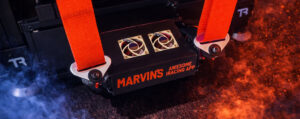

Feel the forces for real. The MAIRA Seat Belt Tensioner is all about turning acceleration telemetry into body-load sensation. This DIY belt feedback system blends surge, sway, and heave into independent left and right shoulder tension, tightening and relaxing the belts to mirror braking, acceleration, cornering, and vertical impacts. Unlike motion rigs that shine with quick jolts, the SBT can hold sustained belt pressure, giving you a clearer feel for ongoing load and making the car easier to read without needing a full motion rig. Built with off-the-shelf components, 3D-printed parts, and clear step-by-step assembly guidance, it’s designed to be builder-friendly, easy to mount, and seriously immersive once you’re strapped in. This also works for all games supported by SimHub – not just iRacing.


This section is where the helmet comes off and the story begins. Learn about Marvin—the sim racer, tinkerer, and slightly obsessive engineer behind MAIRA—and how years of racing, game development, and “there has to be a better way” moments turned into the app you’re using today. Here you’ll find background on the ideas that shaped MAIRA, a look inside Marvin’s personal sim rig and hardware choices, and the philosophy that drives every feature. It’s part origin story, part rig tour, and part friendly reminder that MAIRA was built by a sim racer, for sim racers.


This is where the community takes the wheel. The Media section brings together videos from sim racers, creators, and reviewers around the world who have spent time with MAIRA and shared their experiences. From deep-dive tutorials and force-feedback breakdowns to first impressions and long-term usage stories, this is the place to see how MAIRA performs outside the lab and out on the virtual track. If you’re curious how other drivers use it, tune it, or push it to its limits, this is the highlight reel — real voices, real rigs, and real opinions, all in one place.


Looking for Classic MAIRA? You can find version 1.13 here –

https://herboldracing.com/marvins-awesome-iracing-app-maira/